Guide
Pierre Mahéo Still Loves Flannel. His Office Doesn't.
Officine Générale founder Pierre Mahéo still wears his flannel suit jacket but retired the trousers, too heavy for an office day, revealing how one fabric's weight dictates what actually survives in a wardrobe.
Published
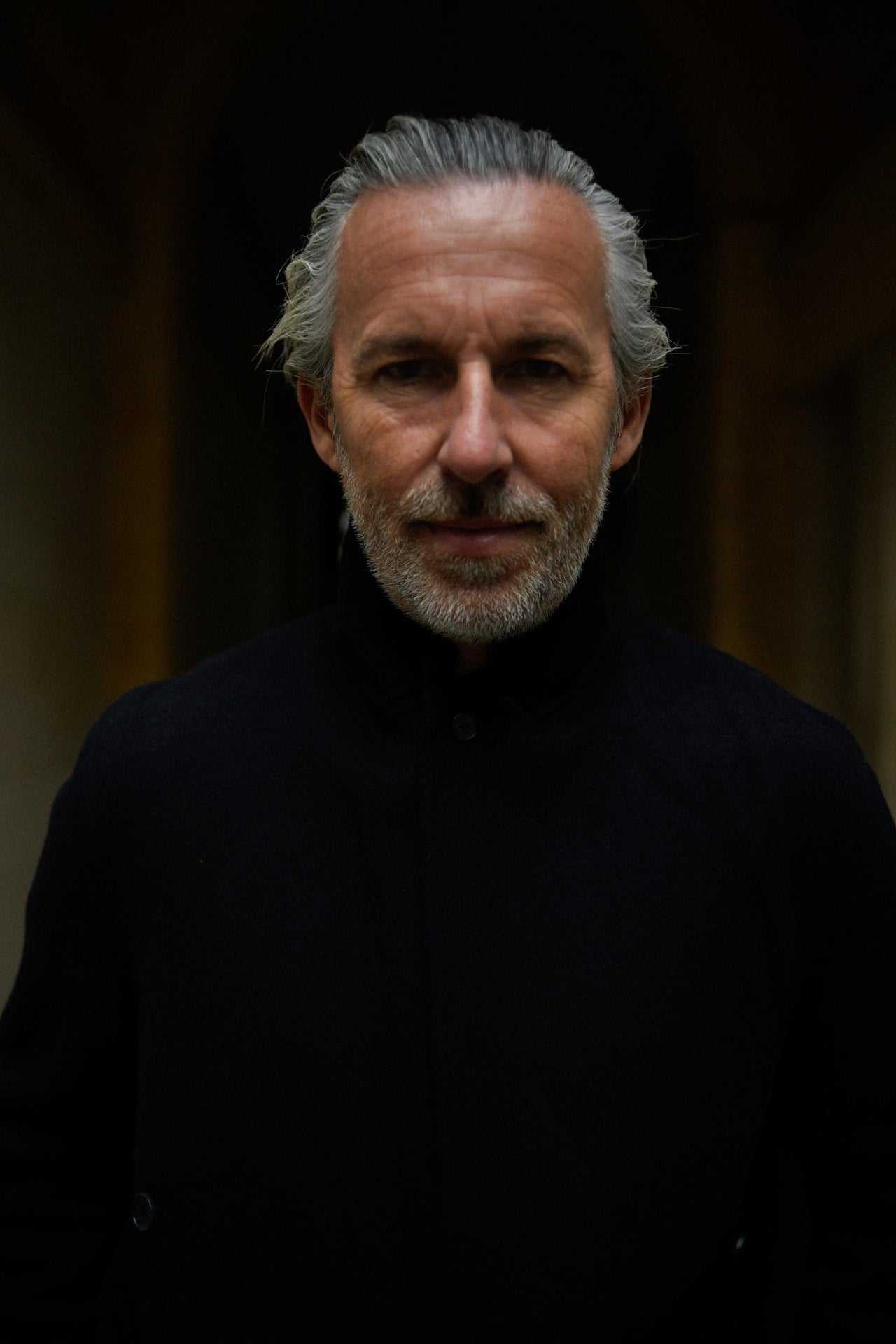
Pierre Mahéo will tell you, without much hesitation, that he has a problem with his own favorite fabric. "I am maybe the biggest fan of traditional flannel," the founder and creative director of Officine Générale told FashionBeans, "but I can't wear it anymore." The suit survives only in pieces: he still reaches for the jacket, but the trousers, he says, sit too heavy for a day at a Paris office that no longer runs on radiators and wool.
That split, jacket kept, trousers retired, says more about how a fabric ages on a body than any season's trend report does. Flannel is a weave as much as a weight: wool carded and brushed until the surface softens, which is exactly what makes it warm, and exactly what makes four or five hours in heated offices and crowded Métro cars feel like wearing a blanket with buttons. A jacket, cut looser and worn over a shirt, breathes. Trousers sit against skin and shift with every stride, so the same cloth that reads as cozy on the shoulders reads as suffocating at the knee. Mahéo's fix is not to abandon the fabric but to relocate it: let it do its job up top, where airflow and distance from skin forgive the weight, and swap it out below for something that does not.
That instinct matches what he has said elsewhere about how he builds a collection. In an interview with Harry Rosen, Mahéo put it plainly: most of the time, he starts with fabric, and shape comes second. It is a workable method for a brand whose trousers and jackets are frequently cut from the same families of cloth but rarely the same weights, since a flannel that reads right across the shoulders can be entirely wrong once it reaches the waistband.
Officine Générale sources its cloth from mills in Britain, Italy and Japan and sends garments to be made in Portugal, Italy, Lithuania and occasionally France, a production map the brand discloses in part through a third-party traceability platform, Trace for Good, which lists origin across creation, weaving and dyeing stages without naming the factories themselves. That is transparency at the level of country and process, not of address, which matters for anyone trying to judge how a given flannel suit was actually assembled rather than taking the label's word for it.
It also matters for upkeep. A flannel jacket worn on its own, without the trousers riding alongside it, wears unevenly over a season: the surface naps down fastest where a bag strap or a coat sleeve rubs against it, and brushing it out with a soft clothes brush after a few wears keeps that nap from flattening into shine at the shoulder blades. Flannel trousers, by contrast, take the brunt of sitting and walking and need pressing more often to hold a crease, one more reason an office-bound wearer might quietly let them go while keeping the jacket in rotation for years.
Mahéo has built his label's identity on resisting exactly the kind of logo-driven shorthand that makes clothes legible from across a room. In a Textilwirtschaft interview he said flatly that he does not sell a hoodie with a logo on it. Flannel, worn as he wears it now, half the suit instead of the whole, fits that same instinct: a fabric recognizable by hand and texture rather than by branding, chosen piece by piece for what it actually does on a body rather than what it signals.
The practical cost of that choice shows up at checkout as much as at the tailor. A flannel jacket from Officine Générale typically runs several hundred dollars more than a cotton or linen equivalent because the wool itself costs more to weave and finish, and because the brand's production in Portugal and Italy carries higher labor costs than fast-turnaround factories elsewhere. Buying the jacket alone, skipping the trousers, is also a way of managing that spend: one durable piece that earns its price over a decade of wear, instead of a full suit where half the garment spends most of the year in a closet.
Availability follows the same logic. Officine Générale has expanded steadily in the United States, with stores in SoHo, two locations in Los Angeles and a second New York outpost on Madison Avenue, a buildout backed in part by investment from the New York fund the Untitled Group, reported by Business of Fashion as aimed at a dozen new stores. American customers now shop the same flannel jacket Mahéo wears in Paris, but in climates, Los Angeles among them, where even the jacket half of his old suit might be too much most of the year.
Which raises the real tension underneath his comment to FashionBeans: a fabric built for a Paris winter is being sold into a retail footprint that increasingly skews warm. Mahéo's answer is not to stop loving flannel. It is to keep wearing less of it, and to let the cut of a single jacket carry the weight the whole suit used to.
